Thursday, November 8, 2018

Printed + Painted Cityscapes

We have been continuing our exploration of lines in PK and Kindergarten and connected them together to make shapes. We used paint, but this time we did not use a paintbrush or water cups. Instead, we used a new technique: printing! We learned to make lines and shapes using cardboard. 
First we dipped the cardboard into paint, then pressed it onto our paper and lifted it up to make a mark. Dip, press, lift. We noticed that we could connect the lines to make them into shapes, and make different lines by changing the way we put our marks down on our paper. 
PK and Kindergarten artists created busy cityscapes, with tall skyscrapers, apartment buildings, hotels, stores, cars, and even people. We had a lot of fun coming up with our own cityscapes, using our printed lines and shapes to inspire our imaginations. 
We tried our best to fill up our paper and included the sun, clouds and even helicopters in the sky. Some students chose to create a rainy or stormy day in their city.
The following class, we added color using tempera paint. We thought about how to make our colors bright to fill in our shapes, making sure to get plenty of paint on our paint brush, as well as fill in the background. Take a look at some of our printed and painted cityscapes:
Annie, Kindergarten (Segreve)
Charlotte, Kindergarten (Bolton)
Colby, Kindergarten (Mattson)
Elyse, Kindergarten (Beatty)
Hudson, Kindergarten (Segreve)
Jeremiah, Kindergarten (Bolton)
John, PK (Martignetti)
Leo, Kindergarten (Mattson)
Lia, Kindergarten (Tan)
Matthew, Kindergarten (Beatty)
Nareg, Kindergarten (Blackwood)
Shriya, Kindergarten (Segreve)
Zoha, Kindergarten (Tan)

Friday, October 26, 2018

Printing Robots

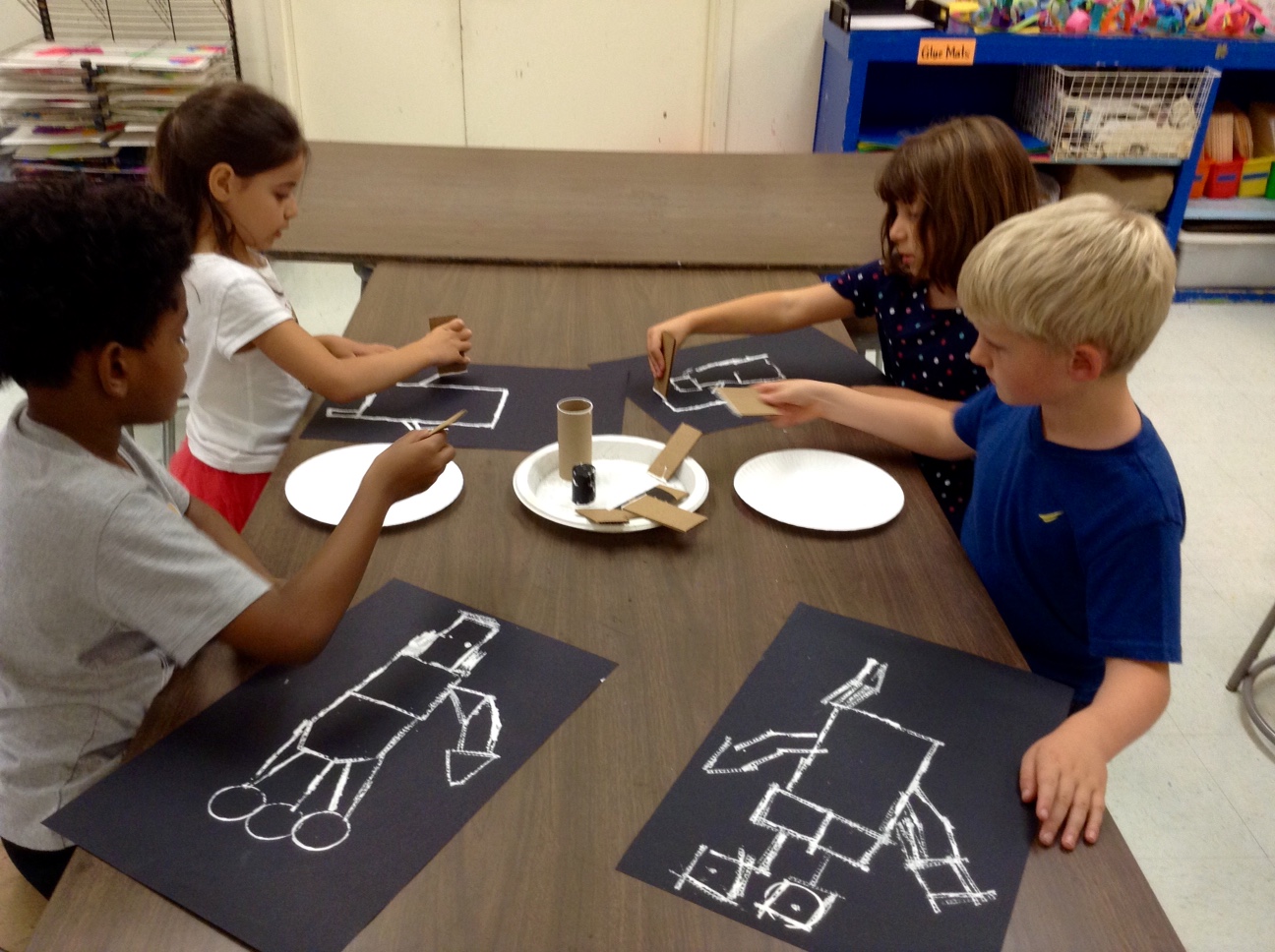
1st grade students recently created printed robots, using cardboard and recycled materials to print or stamp paint on paper. Many students connected this to the cityscape prints they made as Kindergarten students! 
To print, we dipped the cardboard into the paint, then pressed it down on the paper and lifted it up to make a mark. We connected out lines together to make shapes to form our robot's body. We focused on four different shapes that we have learned about: square, rectangle, circle and triangle. As a challenge, artists had to include all four shapes in their artwork at least once!
We thought carefully about what different parts we wanted to add to our robots and what shapes might work best. Students also focused on using the whole paper for their robot and making their robot nice and big! 
After our printed robots dried, the following week students used oil pastel to add color to their robot. This year we got some new metallic oil pastels, which added some shiny metallic color to our artwork! We focused on the robot's body and experimented with layering and blending oil pastel colors together. 
We also talked about what our robots could do. Some of the robots help with homework and chores, cleaning and tidying rooms, protecting people, gathering information and making our favorite dinners! 
After we were done with our robots, we shared our artwork with a partner during a turn & talk. We shared our robots jobs with our partners and also swapped artwork and were able to identify the four different shapes in our partner's artwork. Here are some of our robots and their special jobs, below:
Amar, 1st Grade (McIsaac)
"My robot protects me from bad guys."
Audrey, 1st Grade (Landay)
"My robot cleans up my toys."
Cailin, 1st Grade (Salvucci)
"My robot will keep my baby sister Lillian quiet at night."
Elena, 1st Grade (Salvucci)
"My robot washes the dishes."
Ethan, 1st Grade (Salvucci)
"My robot will do my homework."
Harrison, 1st Grade (Salvucci)
"My robot is my babysitter."
Inty, 1st Grade (Landay)
"My robot does my chores."
Jacob, 1st Grade (Talamas)
"My robot helps me find the bathroom."
Joel, 1st Grade (Salvucci)
"My robot helps me with my homework."
Kaleb, 1st Grade (Landay)
"My robot helps me with my homework."
Kaylie, 1st Grade (Mandile)
"My robot plays with people."
Lucy, 1st Grade (Massa)
"My robot does everything for me."
Mateo, 1st Grade (McIsaac)
"My robot is a police robot and chases bad guys."
Sorayah, 1st Grade (Mandile)
"My robot plays with people."
Zoe, 1st Grade (Massa)
"My robot makes me dinner."

Monday, October 22, 2018

Lines, Lines, Lines

PK and Kindergarten artists started off the year by exploring line! Lines are a traveling mark, created when a dot goes for a walk. They help define the edges of shapes and space, and we can see them all around us! We learned about the names of different lines, including straight, wavy, zig-zag, curly, dotted and spiral. We also created some of our own, including a "circle line," "bumpy line" and "castle line"! 
Using oil pastels, students drew a variety of different lines in their "line challenge" drawings, making them go all the way across their paper. They drew lines that we had learned about, like straight and zig-zag lines, and invented new lines from their imagination. They also tried combining different lines together. 
Next class, we explored what happens when we add paint on top of our oil pastel lines. We watched a demonstration of paint on top of oil pastel and noticed that we could still see the oil pastel lines through the paint -- as one student said, it worked like magic! We learned that this is because the oil pastel and paint are made of different materials so instead of mixing together, they move away from each other. This is called resist! 
Students painted on top of their oil pastel lines, working on washing out their brush between colors and trying to cover the entire paper with paint. It was fun to see resist in action, and watch our lines magically show up through the paint! It was especially fun with the lines we made using white oil pastel. Below are examples of our artwork, some of which are on display on the bulletin board in the connector hallway! 
Alessandra, Kindergarten (Tan)
Astrid, Kindergarten (Bolton)
Billy, Kindergarten (Beatty)
Dara, Kindergarten (Blackwood)
Joaquin, Kindergarten (Blackwood)
Lilyana, Kindergarten (Mattson)
Rosa, Kindergarten (Beatty)
Sona, Kindergarten (Segreve)
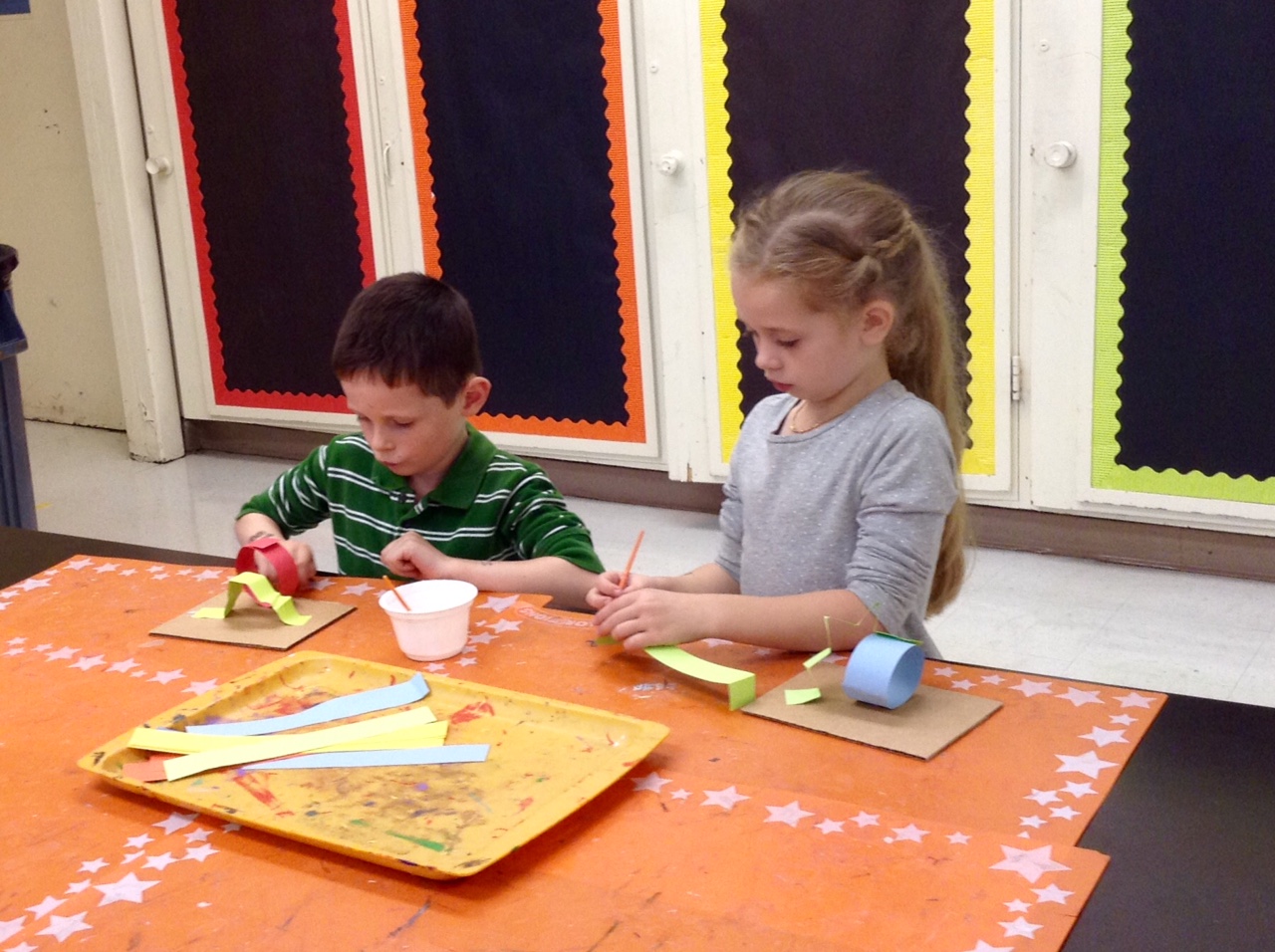
Continuing their study of line, PK and Kindergarten artists took their lines and shapes into the third dimension! They were challenged to think of different ways to change and manipulate flat, straight lines of paper and transform them into 3D lines and shapes. We began by learning about the difference between two-dimensional and three-dimensional objects. Many students thought about having been to a 3D movie, and how objects look like they are popping out at you. We thought about how we could change a piece of paper from two dimensional, flat pieces to three dimensional forms that pop out and stand up, just by using our hands. 
We came up with a few different techniques, including folding and bending the paper. We learned how to fold it to make a zig-zag line, and how to fold the ends of a curved piece of paper to create feet to help it stand up when glued. Then we began to work on our own 3D sculptures. 
Starting with a cardboard base, students added colorful 3D lines and shapes by changing the paper in a variety of different ways. We discovered even more ways we could change the paper, and creative ways to connect and add them to our sculptures. Students added lines and shapes on top of each other, overlapping them, and also thought about trying to fill up their cardboard base. 
Some students were inspired by amusement parks, race tracks, even outer space! Some of our sculptures are on display on the first floor of Hosmer, near the entrance by the Pre-School, so be sure to check them out!