Monday, February 6, 2017

Family Traditions Collage

Last month, 1st grade artists created mixed media collage artworks that tell the story of a family memory or tradition. We began by looking at two paintings by the Mexican American artist, Carmen Lomas Garza. Students were asked to look at the artwork carefully and then think about what is happening and what supports their thinking. 
Carmen Lomas Garza, Empanadas (1991)
Students noticed that there is a family gathered together in a kitchen, making food together. Perhaps it is for a holiday, birthday, or family gathering. Many students connected this to an experience they have had making food with their families, especially in preparation for a holiday or family dinner. We looked at another work by Lomas Garza and students noticed that there was a girl hitting a pinata, a cake on a table, and many people of different ages gathered together, so it might be a birthday party. Our observations helped us to "read" the painting and understand the story visually, without words.
Carmen Lomas Garza, Barbacoa para Cumpleaños (1993)
We noticed that the artist paints the story, using a lot of details to help us understand what is happening. Carmen Lomas Garza is a Mexican American artist who was born in Texas. She paints about her experiences as a Mexican American and her paintings feature her family. Students thought about a time they have spent with their family and family traditions they have experienced. They tried to remember who was there, where it took place, and what people were doing. Then they made their own sketches and drawings of this memory. 
For many students, it was a family tradition or annual event such as Christmas, Hanukkah, or Thanksgiving. For others, they remembered their birthday or a sibling's birthday. Some students drew about a family summer vacation to the beach or a long roadtrip, while others drew about playing in the park, weekend picnics, and building snowmen. 
The following week, students used their sketches and created a painted background for their artwork. Removing the details, students painted paper with solid colors for their background, whether it was yellow sand, blue sky or white snow. We let the painted paper dry and the next class, students began adding the people and details in their foreground using a variety of different materials. 
Students cut and tore shapes from colored paper, tissue paper, fabric, felt, and yarn and put them together to created a mixed media collage of their family memory. Students thought carefully about how the colors, patterns and textures of the materials would help tell their visual story. They tried to make the setting clear, whether it was indoors or outdoors, daytime or nighttime. 
Students worked very hard on these mixed media collages, and wrote a sentence on the back about their work, describing the memory or tradition. We participated in our first gallery walk, which is when we walk around the room to observe everyone's artwork. During a gallery walk we make sure not to touch the artwork, just like at a museum. 
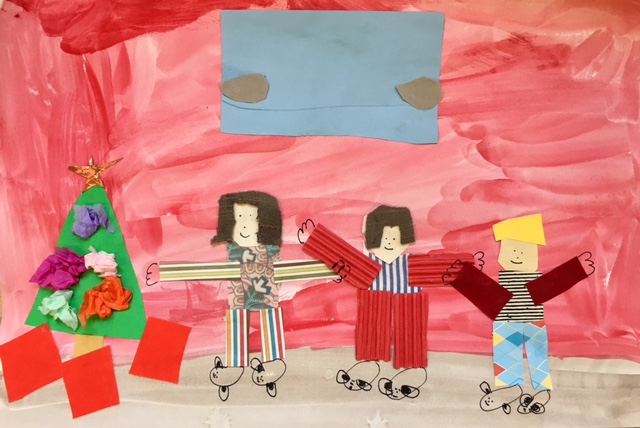
We also did our first turn and talk, where we picked a partner and shared our artwork with them. Students took turns talking about their work and asking questions, considering what their work was about, what they were proudest of in their work, and what was the most challenging part of creating it. At the end of class, we shared them with class on the rug so that everyone could take a look at the finished work, and we could learn more about each student's story. Below are some examples of our work, with a description written by the student.  
Ava, 1st Grade (Landay)
"Building a snowman with my family."
Adriana, 1st Grade (Landay)
"Celebrating Christmas with my family."
Anthony, 1st Grade (Massa)
"Christmas Eve with my family."
Emma, 1st Grade (Landay)
"At the park."
James, 1st Grade (Massa)
"Christmas Day - me and my family."
Megan, 1st Grade (Massa)
"At the playground with my family."
Tigran, 1st Grade (Landay)
"At the beach with my family"
Noa, 1st Grade (Torchio)
"Me and my family in our backyard."
Mary, 1st Grade (Torchio)
"At my aunt's pool with my family."
David, 1st Grade (Mandile)
"At a picnic in the forest with my family."
Graham, 1st Grade (Massa)
"At Cape Cod with my family, grandma and Papa G. I caught 21 hermit crabs in a day!"
Tyler, 1st Grade (Massa)
"Christmas Day with my family."
Ruken, 1st Grade (Salvucci)
"Trick or treating with my family and we saw the scariest house!"
Bianca, 1st Grade (Salvucci)
"At the beach in Maine with my family."
Faye, 1st Grade (Salvucci)
"At the beach with my family."
Tia, 1st Grade (Mandile)
"Celebrating Eid with my family."
Jayden, 1st Grade (Mandile)
"My family came to school."
Corinne, 1st Grade (Mandile)
"Every summer I go to the beach in California with my family."

Sunday, January 29, 2017

Arts Around the World: Kandinsky & Onion Domes from Russia

The second country in our Arts Around the World journey this year is Russia. 2nd grade students began by learning about the country, including where it is located and it's capital city, Moscow. 
Then we read The Noisy Paint Box: The Colors and Sounds of Kandinsky's Abstract Art. We learned that Vasily Kandinsky grew up in Russia, learning piano and math and history. His family also sent him to art classes, where they expected him to paint houses, people and flowers—like a "proper" artist. But when Kandinsky painted, he heard sounds and connected elements of music to colors and shapes. 
He wanted to show how music made him feel, and to paint a symphony of colors and shapes. He became one of the first painters of abstract art, focusing on shapes, lines, and colors, rather than recognizable objects. 
Kandinsky, Composition VII (1913)
Students first explored this idea by drawing to music, listening to different classical pieces by Russian composers that they would learn about in music class, such as Tchaikovsky, Stravinsky, Mussorgsky, and Rachmaninoff. Students used oil pastels to draw a variety of different shapes and lines, using different colors. Some students interpreted different parts of the music using darker or brighter colors, faster or lighter strokes, and curved or straight lines. 
The following class, we added watercolor paint and learned about the technique of wet-on-wet. In this technique, we made the paper wet by first painting a light wash of water, then dripping or dotting paint on top. We noticed that the paint moved around and created interesting and unexpected effects. 
We also noticed that the watercolor paint did not cover the oil pastel, but moved away from it. This demonstrated resist, where materials move apart. Below are some examples of our abstract artworks, inspired by Kandinsky.
Brian, 2nd Grade (Pearse)
Eleni, 2nd Grade (O'Connor)
Ethan, 2nd Grade (McIsaac)
Kaylee M., 2nd Grade (Pearse)
Shane, 2nd Grade (O'Connor)
Sofia, 2nd Grade (O'Connor)
For our second Russia art project, students learned about onion domes. We looked at an image of a building in Moscow and students pointed out the colorful shapes and patterns that they noticed, as well as the "Hershey's Kiss" shaped tops to some of the towers! We learned that these are called onion domes for their shape and they are an architectural feature first started in Russia. Onion domes are often seen on churches in Russia but have now spread to many other areas of the world and are seen on many different houses of worship. 
Russian onion domes are often very colorful and brightly patterned. Students also noticed that many of the designs had textural details. We designed and drew our own buildings with onion domes using oil pastel on black paper. Using a white pencil, students first started with larger shapes and added smaller details as windows, doors, and decorative details. 
Students had to include at least two onion domes in their building and although many of the buildings we looked at were symmetrical in their design, students could choose to make them asymmetrical as well. Some students chose to hold their paper horizontally and others chose to design vertically. 
Students also looked at images of Russian buildings with onion domes as reference. After sketching out their design with the white pencil, students used oil pastel to add color to their work. We reviewed complementary colors and also noticed that lighter colors, like white and light pink, stood out better on the black paper than colors like dark purple. We also talked about how, if you wanted to use a darker color, you could use a contrasting lighter color around it to help it stand out. 
Students spent some time on their buildings with onion domes and it shows! Below are some examples:
Aaron, 2nd Grade (McIsaac)
Wyatt, 2nd Grade (McCarthy)
Dayton, 2nd Grade (McCarthy)
Ana, 2nd Grade (Pearse)
Dylon Z., 2nd Grade (Hinds)
Kemiyoda, 2nd Grade (Pearse)
Paulo, 2nd Grade (Pearse)
Noah, 2nd Grade (O'Connor)
Mera, 2nd Grade (McIsaac)
Evelyn, 2nd Grade (Pearse)

Tuesday, January 17, 2017

Snowmen at Night Chalk Pastel Drawings

After learning about using value to show a three-dimensional form in their personal object still life drawings, 5th grade artists applied the same concept using a different material. We read the story, Snowmen at Night, and looked closely at the illustrations to inspire our own sketches for what our snowmen (or snow people) could be doing. 
Some ideas we came up with included making snow angels, skiing, snowboarding, snowball fights, and playing pond hockey. In their sketch, students had to show some sort of action, and include a light source, whether it was the moon, a lamp, or a fire. 
Using their sketch to guide them, students then used chalk pastel to draw their own snowmen at night scene on larger colored paper. We discussed how to use other colors in combination with white to create a three-dimensional appearance to the snow. We noticed that the illustrations in the book included many colors in addition to white to represent snow. For the areas of shadow, we used different shades of blue, purple, black and gray. For the areas of highlight, we used yellows and oranges to show light hitting a surface. This all depended on the light source in each student's work, and which side of the snowman was closest to it. (Most) students enjoyed blending the soft pastel with their finger to blend colors together and fill in shapes. 
The following classes, we focused on adding details to the snowmen as well as the background. Students got creative with their details, adding faces, winter accessories likes hats and scarves, trees, and even snow animals. We talked about how to add the shading and highlight to those details, such as the carrot nose or a top hat. 
Students also considered different ways to approach the sky, whether it was adding snowflakes, stars, etc. Below are some examples of our snowmen at night drawings. Two students' drawings were featured on the December winter concert program and some of our other snowmen at night drawings are now on display in the glass case downstairs. Be sure to check them out!
Chris, 5th Grade (Twomey)
Grace, 5th Grade (Twomey)
Ani, 5th Grade (Psychoghios)
Armani, 5th Grade (Bellis)
Celia, 5th Grade (Bellis)
Dorothy, 5th Grade (Psychoghios)
Elena, 5th Grade (Bellis)
Halle, 5th Grade (Bellis)
Ilana, 5th Grade (Bellis)
John, 5th Grade (Bellis)
Lindsay, 5th Grade (Domermuth Fantasia)
Tiffany, 5th Grade (Domermuth Fantasia)
Anna L., 5th Grade (Psychoghios)
Cyrus, 5th Grade (Bellis)
Danny, 5th Grade (Bellis)
Tracy, 5th Grade (Twomey)