Showing posts with label Color Wheel. Show all posts

Wednesday, December 21, 2016

Color Mixing and Naming

Last week, artists in 3rd grade explored color mixing in preparation for an upcoming project! We mixed 10 different colors and also came up with a unique name for each color. We looked at examples of paint chips and noticed that many names were inspired by animals, nature, food, and the weather. 
First, students explored color mixing, trying to come up with 10 different colors for their palette. We discussed how you might try to create a color that you already have in mind, like a light pink, or just see what happens if you mix a lot of yellow, a little blue, and some white. 
Since we had just painted a color wheel with primary, secondary and tertiary colors, students were familiar with which colors to mix together to get a wide range of colors. We also experimented with adding white and black to colors, noting how it made colors lighter or darker. 
After creating the colors, students thought of creative names for each color. Instead of simply naming colors "green" or "orange," students were challenged to come up with creative names like "forest green" and "pumpkin pie." The following class, we partnered up and shared our paint colors and corresponding names with our partners. We shared our favorite color names with each other and then with the whole class. A lot of students used alliteration, which is when you repeat the same letter at the beginning of your words, like "pig pink" and "grass green." Check out some of our creative names for colors below! 


Wednesday, December 16, 2015

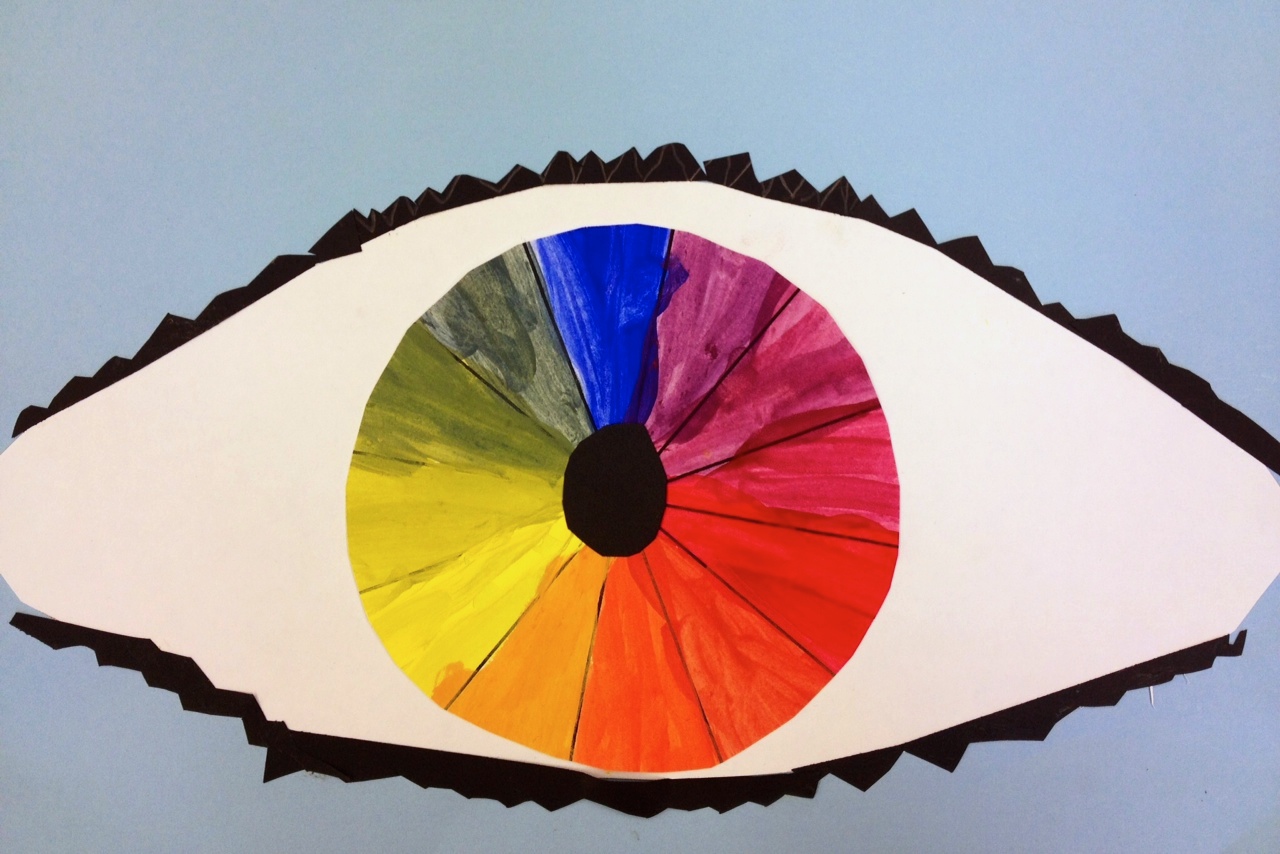
Color Wheel Eyes

After exploring the color orange and making our pumpkin paintings, 3rd grade artists learned about the color wheel. Last year, as 2nd graders, they painted a color wheel with the three primary colors (red, yellow and blue) and three secondary colors (orange, green and violet). 
This year, we expanded to include six tertiary colors. Tertiary colors are combinations of primary and secondary colors. There are six tertiary colors: red-orange, yellow-orange, yellow-green, blue-green, blue-violet, and red-violet. An easy way to remember these names is to put the primary color name before the secondary color. 
Students started by painting their primary colors, and then mixing their secondary colors. We thought about how to make the secondary color look different than the tertiary colors, and we remembered than when we were mixing different shades of orange, if you added more red it was darker, or a red-orange, and if you added more yellow it made it lighter, or yellow-orange. 
Once the color wheels dried, we transformed them into eyes through collage. First, we learned about two parts of the eye, the pupil and the iris. The pupil is the black circle in the center of the iris. It changes size, getting bigger or smaller, depending on the amount of light going through, to help us see. The iris is the colored circle around the pupil, and it works with the pupil as it changes size. 
After cutting out the color wheel, students drew an eye shape on white paper, placing the color wheel in the center to help create a lemon shape around it. Then students glued the white eye shape and color wheel on top of a background and used black paper to add details, like eyelashes and eyebrows. 
We discussed what shapes might work best for the eyelashes, and many students chose to cut long triangles, rectangles, and some students also curled the ends to lift off the paper. Below are some examples of our color wheel eye collages.
Jaylyn, 3rd grade (Monfette)
Jason, 3rd grade (Fletcher)
Zach, 3rd grade (Monfette)
Pirada, 3rd grade (Stone)
Dorie, 3rd grade (Lutz)
Iris, 3rd grade (Lutz)
Gabe, 3rd grade (Fletcher)


Thursday, January 15, 2015

Color Wheel Snowflakes

Recently artists in 2nd and 3rd grade have been exploring color and color mixing. In 2nd grade we painted color wheels, using the primary colors and mixing our secondary colors. Third graders also painted similar color wheels but they also mixed an additional set of colors called tertiary colors, combining the primary and secondary colors to create these intermediate colors. 
We noticed that the color wheel is organized in a way that helps you remember which 2 primary colors make a secondary color, because it is located in between the 2 primary colors that you need to mix:
3rd graders used a color wheel that included tertiary, or intermediate, colors:
For the tertiary colors, students had to consider how much of one color they should use to get red-orange vs. yellow-orange. We noticed that the names of the tertiary colors give you a clue about what colors you need more of. We tested some of our color mixes to make sure we had the color we wanted.
After the color wheels dried, we learned about the concept of radial symmetry, which can be seen in nature. Radial symmetry is symmetry around a central point. We looked at images of snowflakes under a microscope to see how each snowflake had radial symmetry in its design, and are all unique and different.
We learned how to fold our cut out color wheels, starting with folding it in half like a taco and eventually folding it into an ice cream cone shape. We then cut out a variety of shapes, making sure to leave a little space in between our shapes so our finished snowflake would not fall apart. Then it was time for the big reveal as we opened our snowflakes to see our intricate, unique and radially symmetrical designs!
We chose a black or blue background and glued our snowflakes on top. 
Cicily, 3rd Grade
Sidney, 3rd Grade
Nikolas, 3rd Grade
Tiffany, 3rd Grade
Examples from 3rd grade will be displayed in the connector hallway soon, so keep your eye out for our color wheels transformed into snowflakes!