Showing posts with label Shape. Show all posts

Tuesday, April 9, 2019

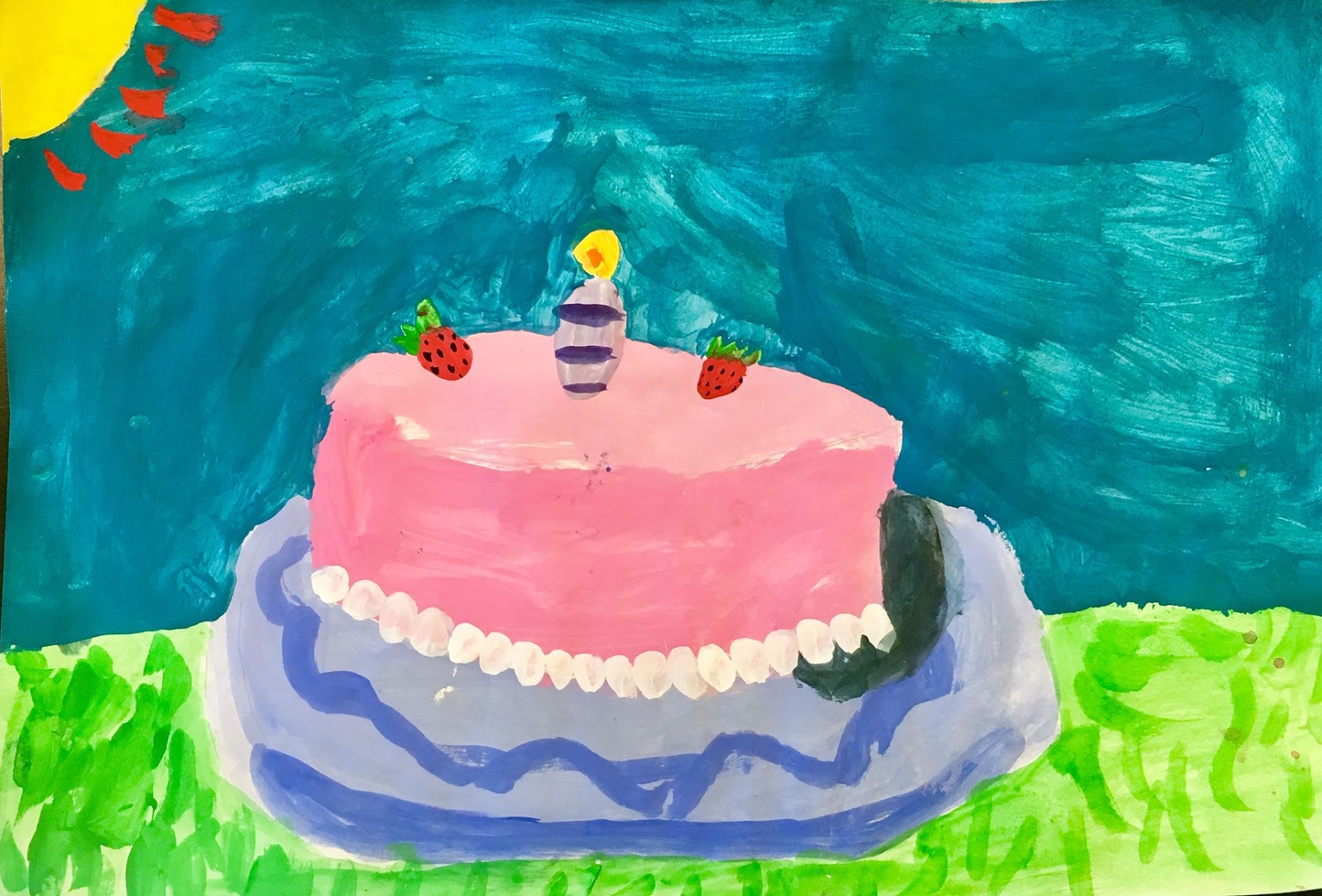
Delicious Desserts, Inspired by Wayne Thiebaud

After exploring color mixing by creating new colors and naming them, 3rd grade artists looked at and discussed the work of American painter Wayne Thiebaud. Thiebaud (pronounced "tee-bow") is known for his paintings of everyday objects, like food, and is still alive and making art today! 
Wayne Thiebaud, Four Ice Cream Cones (1964)
We looked at his paintings of different kinds of desserts and noticed his use of bright colors and dramatic, colorful shadows. Looking at several examples made us hungry! 
To begin our own paintings of desserts, we looked at the geometric shapes and forms that make up a lot of our favorite desserts. We noticed that many desserts are either a cylinder, like a cake or pie; a cone shape, like an ice cream cone; a sphere, like the scoop of ice cream; or a triangular prism, like a slice of cake. We brainstormed and drew a few sketches of our favorite desserts before selecting one to sketch out on larger paper, focusing on the shapes. 
The following class, we used our recent experience with mixing colors to paint our favorite desserts! We thought about how we could mix a variety of colors, thinking about the bright colors that Thiebaud uses in his painting, as well as using white to create lighter tints of a color. 
Students painted their desserts, incorporating tints, and the following week, they added additional details on top, now that the first layer of paint had dried. Students thought about how they could decorate their cakes, ice cream cones, sundaes and doughnuts with creative details like frosting, sprinkles, flowers, candles and hot fudge. 
During the next class, students painted the background, considering the use of a complementary colors and colors that would help their desserts to stand out. Since Thiebaud is also known for his use of strong shadows, we looked at cast shadows and how the shape of the object changes the shape of the shadow. Students added a colorful shadow to their dessert, and many students actually chose to add a window in their background to show a light source. 
For our last class, students participated in a gallery walk to see everyone's artwork and also a turn and talk to share their work with a partner. Here are some colorful examples of our delectable Wayne Thiebaud inspired desserts:
Ditty, 3rd Grade (Fletcher)
Gianna, 3rd Grade (Monfette)
James, 3rd Grade (Donato)
Laisa, 3rd Grade (DeBaie Nickl)
Mane, 3rd Grade (Fletcher)
Mary, 3rd Grade (DeBaie Nickl)
Norah, 3rd Grade (Monfette)
Ruken, 3rd Grade (DeBaie Nickl)
Sean, 3rd Grade (Donato)
Bianca, 3rd Grade (Debaie Nickl)
Duncan, 3rd Grade (Fletcher)
Griffin, 3rd Grade (Fletcher)
Leila, 3rd Grade (Donato)
Mason, 3rd Grade (DeBaie Nickl)
Noa, 3rd Grade (Donato)

Friday, October 26, 2018

Printing Robots

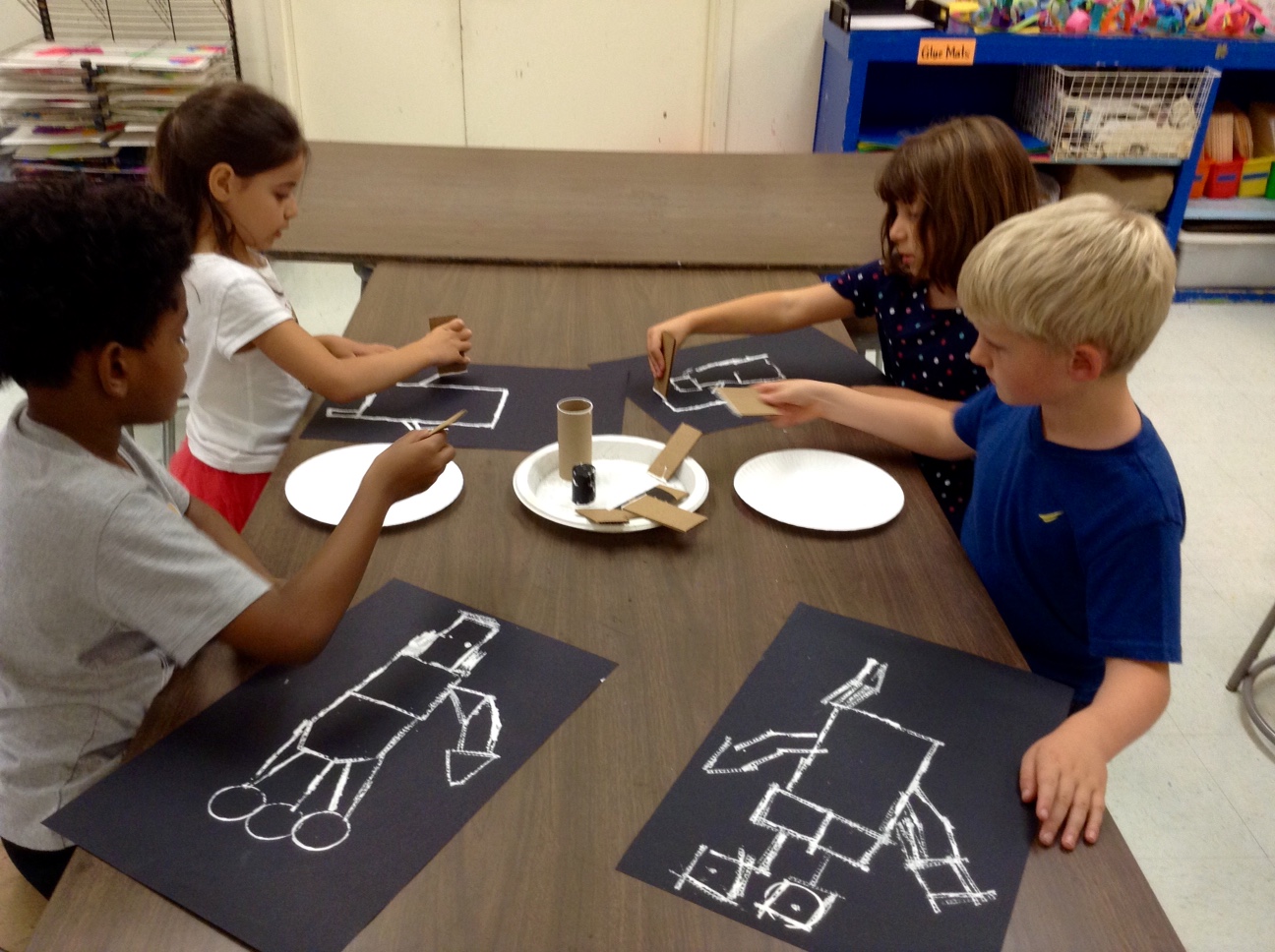
1st grade students recently created printed robots, using cardboard and recycled materials to print or stamp paint on paper. Many students connected this to the cityscape prints they made as Kindergarten students! 
To print, we dipped the cardboard into the paint, then pressed it down on the paper and lifted it up to make a mark. We connected out lines together to make shapes to form our robot's body. We focused on four different shapes that we have learned about: square, rectangle, circle and triangle. As a challenge, artists had to include all four shapes in their artwork at least once!
We thought carefully about what different parts we wanted to add to our robots and what shapes might work best. Students also focused on using the whole paper for their robot and making their robot nice and big! 
After our printed robots dried, the following week students used oil pastel to add color to their robot. This year we got some new metallic oil pastels, which added some shiny metallic color to our artwork! We focused on the robot's body and experimented with layering and blending oil pastel colors together. 
We also talked about what our robots could do. Some of the robots help with homework and chores, cleaning and tidying rooms, protecting people, gathering information and making our favorite dinners! 
After we were done with our robots, we shared our artwork with a partner during a turn & talk. We shared our robots jobs with our partners and also swapped artwork and were able to identify the four different shapes in our partner's artwork. Here are some of our robots and their special jobs, below:
Amar, 1st Grade (McIsaac)
"My robot protects me from bad guys."
Audrey, 1st Grade (Landay)
"My robot cleans up my toys."
Cailin, 1st Grade (Salvucci)
"My robot will keep my baby sister Lillian quiet at night."
Elena, 1st Grade (Salvucci)
"My robot washes the dishes."
Ethan, 1st Grade (Salvucci)
"My robot will do my homework."
Harrison, 1st Grade (Salvucci)
"My robot is my babysitter."
Inty, 1st Grade (Landay)
"My robot does my chores."
Jacob, 1st Grade (Talamas)
"My robot helps me find the bathroom."
Joel, 1st Grade (Salvucci)
"My robot helps me with my homework."
Kaleb, 1st Grade (Landay)
"My robot helps me with my homework."
Kaylie, 1st Grade (Mandile)
"My robot plays with people."
Lucy, 1st Grade (Massa)
"My robot does everything for me."
Mateo, 1st Grade (McIsaac)
"My robot is a police robot and chases bad guys."
Sorayah, 1st Grade (Mandile)
"My robot plays with people."
Zoe, 1st Grade (Massa)
"My robot makes me dinner."

Friday, December 15, 2017

Owl Babies Collage

After listening to the story Owl Babies, by Martin Waddell, PK artists in Ms. Mattson's class made owl collages uses torn paper. First we listened to the story and shared what we knew about owls, such as the fact that owls are nocturnal animals that hunt at night.
We started by tracing the shape of an owl, and then we ripped up some construction paper and glued the pieces inside the body of the owl. We added eyes using circles and a beak using a triangle, as well as feet. Then students used crayons to add a background, such as a tree branch like the branch the baby owls sit on while waiting for their mother, or their home in the tree trunk. Below are some examples of our owl collages:
Adrian, PK (Mattson)
Claire, PK (Mattson)
Des, PK (Mattson)
Devon, PK (Mattson)
Evelyn, PK (Mattson)
Margot, PK (Mattson)
Shemi, PK (Mattson)

Thursday, October 26, 2017

3D Paper Sculptures

Continuing their study of line, PK and Kindergarten artists took their lines and shapes into the third dimension! They were challenged to think of different ways to change and manipulate flat, straight lines of paper and transform them into 3D lines and shapes. We began by learning about the difference between two-dimensional and three-dimensional objects. 
Many students thought about having been to a 3D movie, and how objects look like they are popping out at you. We thought about how we could change a piece of paper from two dimensional, flat pieces to three dimensional forms that pop out and stand up, just by using our hands. We came up with a few different techniques, including folding and bending the paper. We learned how to fold it to make a zig-zag line, and how to fold the ends of a curved piece of paper to create feet to help it stand up when glued. 
Then we began to work on our own 3D sculptures. Starting with a cardboard base, students added colorful 3D lines and shapes by changing the paper in a variety of different ways. We discovered even more ways we could change the paper, and creative ways to connect and add them to our sculptures. 
Students added lines and shapes on top of each other, overlapping them, and also thought about trying to fill up their cardboard base. Some students were inspired by amusement parks, race tracks, even outer space! Some of our sculptures are on display on the first floor of Hosmer, near the entrance by the Pre-School, so be sure to check them out: