Showing posts with label Color Mixing. Show all posts

Tuesday, April 9, 2019

Delicious Desserts, Inspired by Wayne Thiebaud

After exploring color mixing by creating new colors and naming them, 3rd grade artists looked at and discussed the work of American painter Wayne Thiebaud. Thiebaud (pronounced "tee-bow") is known for his paintings of everyday objects, like food, and is still alive and making art today! 
Wayne Thiebaud, Four Ice Cream Cones (1964)
We looked at his paintings of different kinds of desserts and noticed his use of bright colors and dramatic, colorful shadows. Looking at several examples made us hungry! 
To begin our own paintings of desserts, we looked at the geometric shapes and forms that make up a lot of our favorite desserts. We noticed that many desserts are either a cylinder, like a cake or pie; a cone shape, like an ice cream cone; a sphere, like the scoop of ice cream; or a triangular prism, like a slice of cake. We brainstormed and drew a few sketches of our favorite desserts before selecting one to sketch out on larger paper, focusing on the shapes. 
The following class, we used our recent experience with mixing colors to paint our favorite desserts! We thought about how we could mix a variety of colors, thinking about the bright colors that Thiebaud uses in his painting, as well as using white to create lighter tints of a color. 
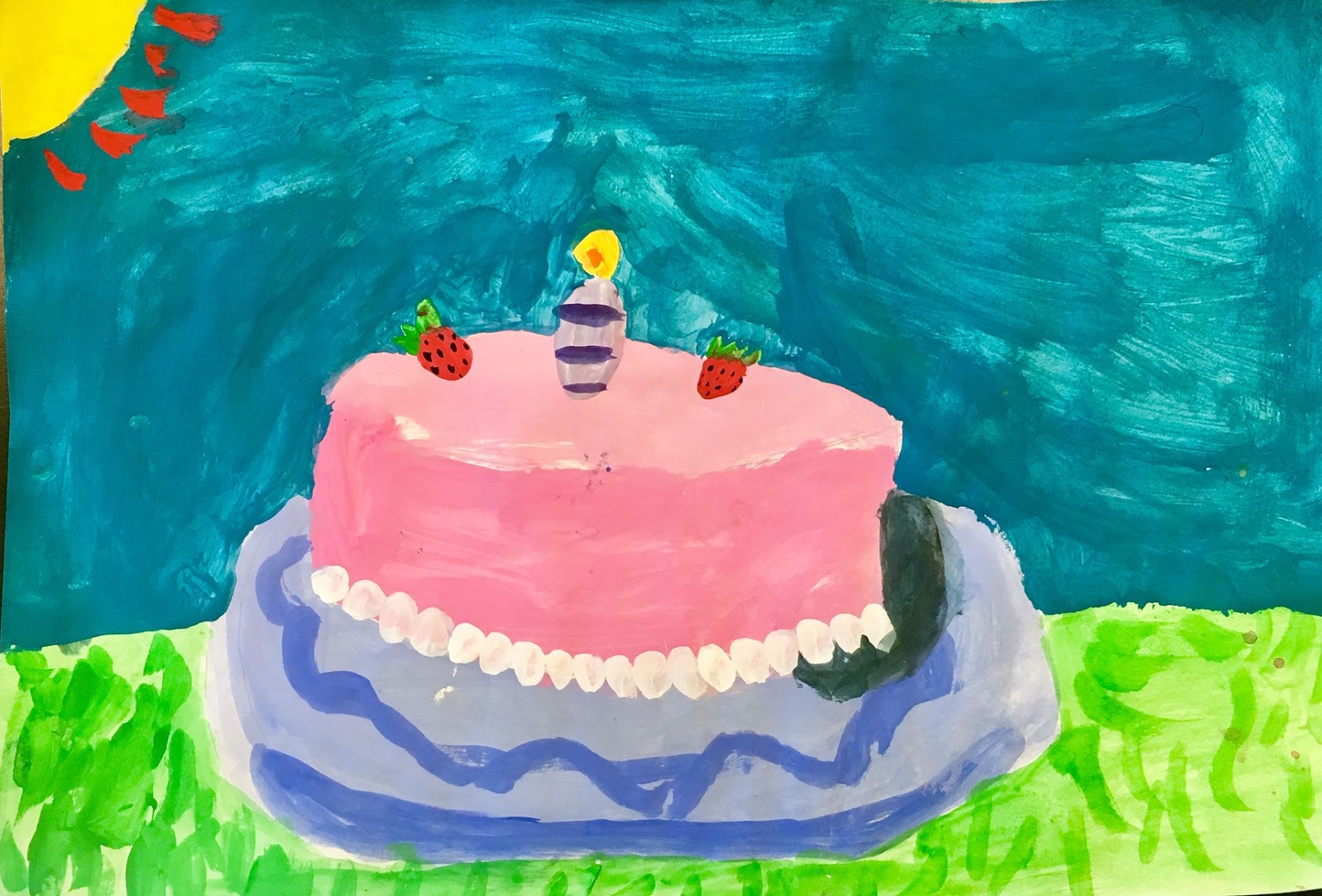
Students painted their desserts, incorporating tints, and the following week, they added additional details on top, now that the first layer of paint had dried. Students thought about how they could decorate their cakes, ice cream cones, sundaes and doughnuts with creative details like frosting, sprinkles, flowers, candles and hot fudge. 
During the next class, students painted the background, considering the use of a complementary colors and colors that would help their desserts to stand out. Since Thiebaud is also known for his use of strong shadows, we looked at cast shadows and how the shape of the object changes the shape of the shadow. Students added a colorful shadow to their dessert, and many students actually chose to add a window in their background to show a light source. 
For our last class, students participated in a gallery walk to see everyone's artwork and also a turn and talk to share their work with a partner. Here are some colorful examples of our delectable Wayne Thiebaud inspired desserts:
Ditty, 3rd Grade (Fletcher)
Gianna, 3rd Grade (Monfette)
James, 3rd Grade (Donato)
Laisa, 3rd Grade (DeBaie Nickl)
Mane, 3rd Grade (Fletcher)
Mary, 3rd Grade (DeBaie Nickl)
Norah, 3rd Grade (Monfette)
Ruken, 3rd Grade (DeBaie Nickl)
Sean, 3rd Grade (Donato)
Bianca, 3rd Grade (Debaie Nickl)
Duncan, 3rd Grade (Fletcher)
Griffin, 3rd Grade (Fletcher)
Leila, 3rd Grade (Donato)
Mason, 3rd Grade (DeBaie Nickl)
Noa, 3rd Grade (Donato)

Thursday, February 7, 2019

Creative Color Mixing and Naming

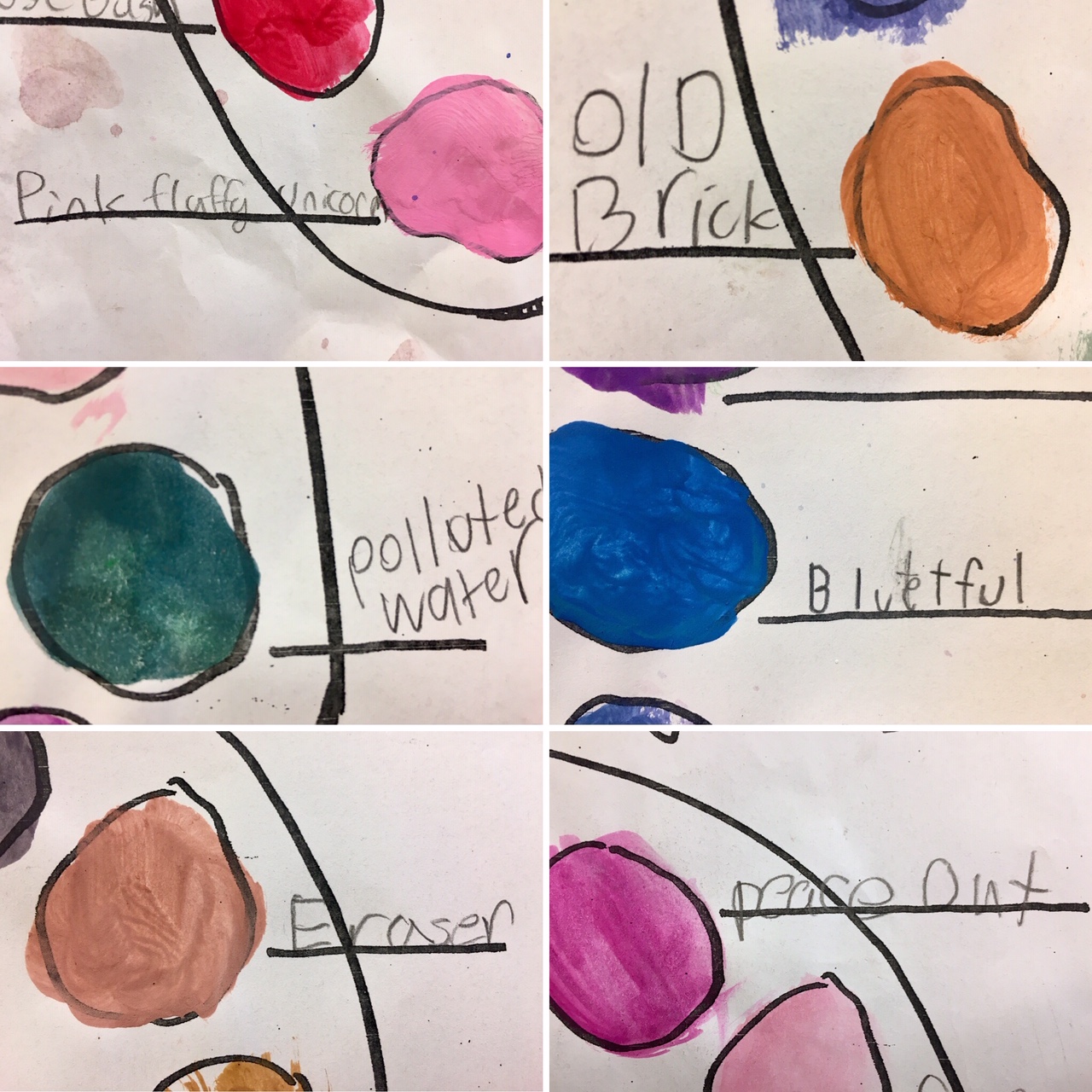
Artists in 3rd grade recently explored color mixing in preparation for an upcoming project! We mixed 10 different colors and also came up with a unique name for each color. 
First, students explored color mixing, trying to come up with 10 different colors for their palette. We discussed how you might try to create a color that you already have in mind, like a light green, or just see what happens if you mix a lot of white, a little blue, and some yellow. Since we had just painted a color wheel with primary, secondary and tertiary colors, students were familiar with which colors to mix together to get a wide range of colors. We also experimented with adding white and black to colors, noting how it made colors lighter or darker. 
The following class, students thought of creative names for each of the colors they had made. Instead of simply naming colors "light pink" or "dark blue," students were challenged to come up with creative names like "cherry blossom pink" and "storm blue." We looked at examples of paint chips and noticed that many names were inspired by animals, nature, food, and the weather. We made a list of things we might be inspired by for color naming and then named all of our colors. 
We shared our paint colors and corresponding names with partners and then with the whole class. A lot of students used alliteration, which is when you repeat the same letter at the beginning of your words, like "pig pink" and "grass green." Check out some of our creative color names below!


Friday, March 2, 2018

Delicious Desserts, Inspired by Wayne Thiebaud

After exploring color mixing by creating new colors and naming them, 3rd grade artists looked at and discussed the work of American painter Wayne Thiebaud. Thiebaud (pronounced "tee-bow") is known for his paintings of everyday objects, like food, and still makes art today.
Wayne Thiebaud, Four Cupcakes (1971) 
We looked at his paintings of different kinds of desserts and noticed his use of bright colors and dramatic, colorful shadows. Looking at several examples made us hungry! To begin our own paintings of desserts, we looked at the geometric shapes and forms that make up a lot of our favorite desserts. 
We noticed that many desserts are either a cylinder, like a cake or pie; a cone shape, like an ice cream cone; a sphere, like the scoop of ice cream; or a triangular prism, like a slice of cake. We brainstormed and drew a few sketches of our favorite desserts before selecting one to sketch out on larger paper, focusing on the shapes.
The following class, we used our recent experience with mixing colors to paint our favorite desserts! We thought about how we could mix a variety of colors, thinking about the bright colors that Thiebaud uses in his painting, as well as using white to create lighter tints of a color. Students painted their desserts, incorporating tints, and the following week, they added additional details on top, now that the first layer of paint had dried. 
Students thought about how they could decorate their cakes, ice cream cones, sundaes and doughnuts with creative details like frosting, sprinkles, flowers, candles and hot fudge. 
During the next class, students painted the background, considering the use of a complementary colors and colors that would help their desserts to stand out. Since Thiebaud is also known for his use of strong shadows, we looked at cast shadows and how the shape of the object changes the shape of the shadow. Students added a colorful shadow to their dessert, and many students actually chose to add a window in their background to show a light source. 
For our last class, students participated in a gallery walk to see everyone's artwork and also a turn and talk to share their work with a partner. Here are some colorful examples of our delectable Wayne Thiebaud inspired desserts:
Isabella, 3rd Grade (Fletcher)
Nicolle, 3rd Grade (Fletcher)
Anna, 3rd Grade (Fletcher)
Joey, 3rd Grade (DeBaie Nickl)
Morgen, 3rd Grade (DeBaie Nickl)
Boran, 3rd Grade (DeBaie Nickl)
Daniel, 3rd Grade (Fletcher)
Jehangeer, 3rd Grade (Fletcher)
Audrina, 3rd Grade (Donato)
Camryn, 3rd Grade (Donato)
Katie, 3rd Grade (Monfette)
Luanna, 3rd Grade (Monfette)
Amanda, 3rd Grade (Monfette)

Thursday, February 1, 2018

David Hockney Inspired Countryside Landscapes

After our Romare Bearden inspired mixed media collage cityscapes, 4th grade artists looked at and discussed the colorful countryside landscapes of British artist, David Hockney. We looked at a few examples of his landscape paintings, including the one below. 
David Hockney, North Yorkshire (1997) 
Students noticed that in comparison to the urban cityscape, Hockney's country landscapes had a lot more fields, hills, trees and details like bales of hay. Students also noticed that Hockney used some very bright colors that are not necessarily natural to a landscape. In the painting above, many students thought the purple lines represented a river, while others thought it was a road. Students also noticed that Hockney included different lines, patterns and textures to add interest to the landscape. Even areas that are all green contain different marks to show the texture of the grass. 
Students spent one class exploring color mixing, mixing different colors by combining two colors together, then three colors together, and even four. We noticed that when you mixed four colors together, they often got a little muddy. Students thought about colors they might want to use in their landscape painting. 
The following class, students sketched out their own countryside landscape, focusing on using lines to create different areas for color. They painted in the different areas of their landscape, mixing their own colors and including at least one tint, or a color mixed with white. Students referred to their color mixing experiments to help mix new colors. 
After this layer of paint dried, during the following class we added patterns on top of the different areas, such as stripes, polka dots, and various lines and shapes. We talked about complementary colors and how you might use these colors for the patterns to help provide contrast with the background color. 
Using smaller brushes, students also added details such as trees, houses, animals, cars, clouds, etc. We talked about how using the smaller brushes can really help with painting small details and sometimes it is about choosing the right tools for the job to make it easier. Students used many different colors and patterns and included details such as animals, barns, trees and fences. Below are examples of our colorful David Hockney inspired landscape paintings.
Artem, 4th Grade (Mattson)
Ethan, 4th Grade (Mattson)
Evey, 4th Grade (Doherty)
Tatiana, 4th Grade (Mattson)
Zarisha, 4th Grade (Doherty)
Desmond, 4th Grade (Graves)
Destanie, 4th Grade (Cikacz)
Gavin, 4th Grade (Graves)
Gustavo, 4th Grade (Doherty)
Jackie, 4th Grade (Cikacz)
Jayden, 4th Grade (Graves)
Maya, 4th Grade (Graves)
Meba, 4th Grade (Mattson)
Pavlos, 4th Grade (Graves)
Sofia, 4th Grade (Mattson)
Vardges, 4th Grade (Doherty)