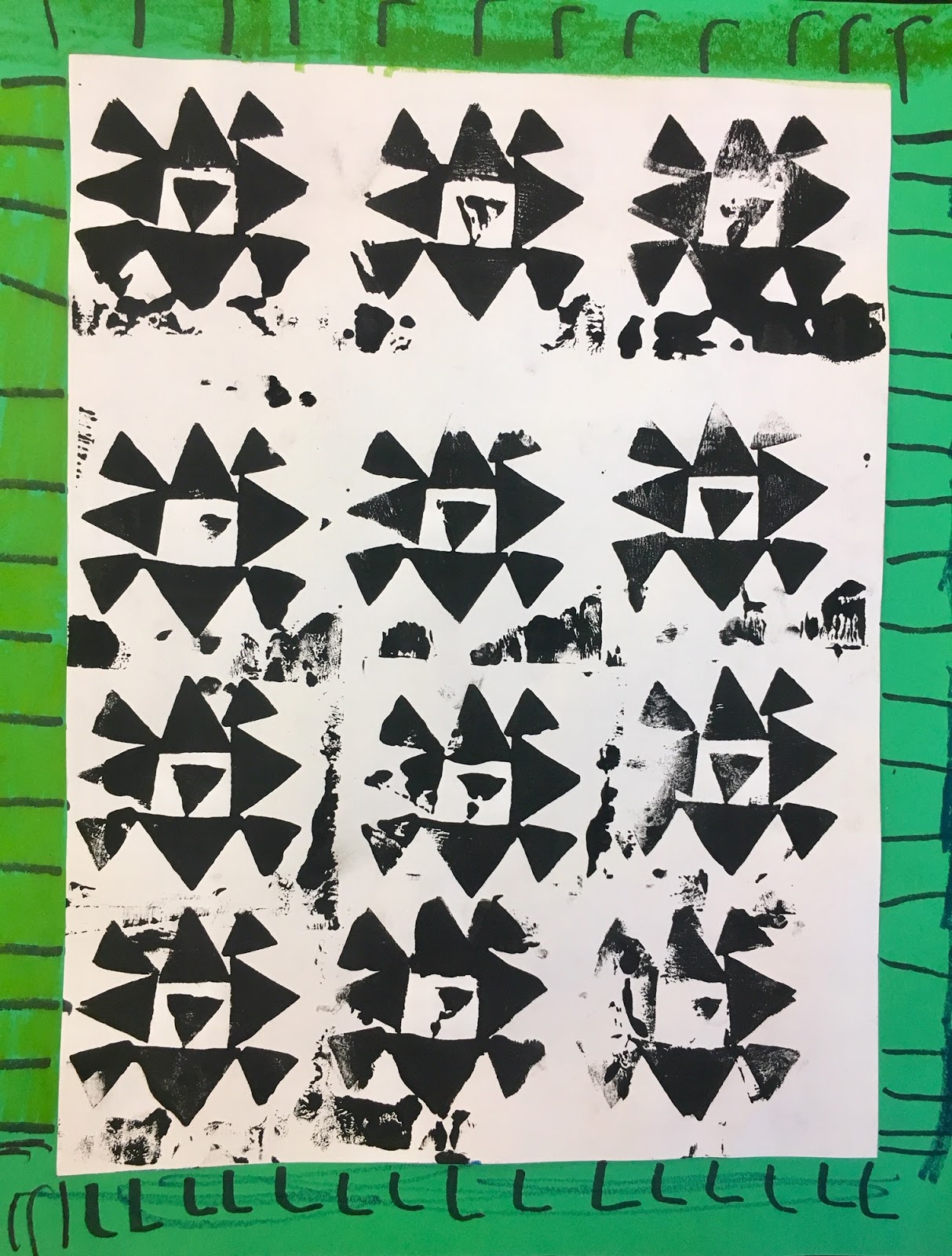
4th grade artists started off the year by learning about the Pop Art movement, which began in the U.S. in the 1950's. Artists focused on objects and scenes from everyday life and popular culture, borrowing techniques from commercial art and popular illustration, like comics and cartoons. We looked at a few examples of screen prints made by Andy Warhol, who made multiple prints of his artwork. A lot of his art featured commercial products that were mass produced, so he chose to mass produce his artwork, as well.
 |
| Andy Warhol, Campbell's Soup Cans (1962) |
After sharing our observations, we discussed what popular culture means to us today. Each class made a list on the whiteboard, which included things like sports teams, music, video games, social media and fashion. Then students brainstormed four different ideas for a print, featuring pop culture imagery that was important or meaningful to them. Students were also given reference images for inspiration, with sports team logos, emojis and cartoon characters, among other things.
Each student selected one of their four ideas to make into a print that would be repeated multiple times. After placing their chosen drawing on top of a piece of styrofoam, students traced over their drawing with a wooden stylus. Then they removed the paper and went over their drawing again, to make the lines deeper. The final step was to go over their lines one more time with a blunt or dull pencil, to make their lines a little wider. Then we cut around the shape to form our printing plate.

On the first day of printing, we learned about the printmaking process and the steps involved. Students pulled their first prints, using yellow ink on purple paper, to get a feel for how much ink is appropriate and how long to roll it out with the brayer.
We set up our tables with a bench hook and brayer to roll out ink. Everyone folded a piece of manila paper so that there was a clean side and a messy side. We rolled out the ink using the brayer, listening for a sticky sound that told us that the ink was evenly spread out and ready. We placed the plate on top of the messy side of our manila paper and rolled the ink on top of our plate carefully. We moved it to the clean side and pressed a piece of colored paper on top.
Using our hands to gently rub, we then flipped the paper and over and pulled it apart from the plate to reveal their print.

For their second printmaking class, students were able to choose their own color of ink and paper. Students made multiple copies with their plate, which the printmaking process allows us to do.
On the third printing day, students created prints using two colors of ink to do a rainbow roll. Using two different colors that met in the middle to form a new color, the rainbow roll gave the prints a gradation effect. Many students enjoyed this effect and their prints from this day.
After our printing classes, students selected our three best prints and mounted them on a black background. Since we had done printmaking for three classes, students had many prints to choose from!
Students thought about which prints came out the most successfully, looking at the amount of ink, and also tried to display different color combinations. Students arranged them in an order before gluing them down. After gluing down their three prints, students signed and titled their work. Many students asked each other for advice and also helped each other brainstorm creative titles!
We did a gallery walk, so we could see everyone's finished work. Students noticed that there were some very popular subjects that came up often, such as unicorns and ghost emojis, but everyone's prints looked different. Many students appreciated the thoughtful and clever titles that their friends were able to come up with, as well! As you can see, students did an amazing job mounting their own work!
 |
| Aaron, 4th grade (Mattson) |
 |
| Abena, 4th grade (Cikacz Wandicho) |
 |
| Darya, 4th grade (Graves) |
 |
| Ellian, 4th grade (Doherty) |
 |
| Etta, 4th grade (Graves) |
 |
| Evelyn, 4th grade (Mattson) |
 |
| Finnley, 4th grade (Doherty) |
 |
| Isabel, 4th grade (Cikacz Wandicho) |
 |
| Kemiyoda, 4th grade (Mattson) |
 |
| Kendyll, 4th grade (Cikacz Wandicho) |
 |
| Nicolle, 4th grade (Doherty) |
 |
| Noah, 4th grade (Graves) |
 |
| Sofia, 4th grade (Doherty) |
 |
| NJ, 4th grade (Mattson) |