Showing posts with label Gallery Walk. Show all posts

Wednesday, March 8, 2017

Colorful Countryside Landscapes, Inspired by David Hockney

After our Romare Bearden inspired mixed media collage cityscapes, 4th grade artists looked at and discussed the colorful countryside landscapes of British artist, David Hockney. We looked at a few examples of his landscape paintings, including the one below. 
David Hockney, North Yorkshire (1997)
Students noticed that in comparison to the urban cityscape, Hockney's country landscapes had a lot more fields, hills, trees and details like bales of hay. Students also noticed that Hockney used some very bright colors that are not necessarily natural to a landscape. In the painting above, many students thought the purple lines represented a river, while others thought it was a road. Students also noticed that Hockney included different lines, patterns and textures to add interest to the landscape. Even areas that are all green contain different marks to show the texture of the grass.
Students spent one class exploring color mixing, mixing different colors by combining two colors together, then three colors together, and even four. We noticed that when you mixed four colors together, they often got a little muddy. Students thought about colors they might want to use in their landscape painting. The following class, students sketched out their own countryside landscape, focusing on using lines to create different areas for color. 
They painted in the different areas of their landscape, mixing their own colors and including at least one tint, or a color mixed with white. Students referred to their color mixing experiments to help mix new colors. 
After this layer of paint dried, during the following class we added patterns on top of the different areas, such as stripes, polka dots, and various lines and shapes. We talked about complementary colors and how you might use these colors for the patterns to help provide contrast with the background color. 
Using smaller brushes, students also added details such as trees, houses, animals, cars, clouds, etc. We talked about how using the smaller brushes can really help with painting small details and sometimes it is about choosing the right tools for the job to make it easier. When we were done with our paintings, we participated in a gallery walk so we could see everyone's work. We noticed that students used many different colors and patterns and included a lot of fun details, such as animals, barns, hot air balloons and tractors. Below are examples of our colorful David Hockney inspired landscape paintings.
Aliana, 4th Grade (Doherty)
Anna, 4th Grade (Cikacz)
Bianca, 4th Grade (Doherty)
Brady, 4th Grade (Graves)
Breanna, 4th Grade (Dubuque)
Jason, 4th Grade (Mattson)
Jaylyn, 4th Grade (Dubuque)
Kate R., 4th Grade (Mattson)
Kate S., 4th Grade (Mattson)
Lucas, 4th Grade (Cikacz)
Mia, 4th Grade (Dubuque)
Nabila, 4th Grade (Graves)
Sila, 4th Grade (Graves)
Yazmin, 4th Grade (Dubuque)

Sunday, February 26, 2017

Romare Bearden Inspired 'My Block' Cityscape Collage

After their Pop Art inspired print project, 4th grade artists looked at the work of another American artist named Romare Bearden. An African American artist, Bearden lived and worked in Harlem, a neighborhood in New York City. We looked at and discussed one of his collage artworks called "The Block." 
Romare Bearden, The Block (1978)
Students noticed that there were many different buildings and details -- windows, people, signs, etc. Students also noticed that some of the buildings looked like they were made of different materials, such as brick. We discussed how the street in a city is very busy, with many different kinds of buildings, such as apartments, restaurants, and stores. We noted that although you can tell that it is a city street, some of the colors, proportions, and views are not completely realistic. For example, some parts of the buildings are cut out so that you can see what is happening inside, and the light bulb in one of the rooms is much larger than the people around it. The longer we looked at it, the more there was to see! 
Then we began our own mixed media collage artwork, using a long piece of construction paper to start the city street. We talked about what kinds of buildings students could add, and how to overlap and layer different materials together to add detail and interest to our street. There were many different materials to choose from, including construction paper, corrugated paper, metallic paper, fabric, felt, tissue paper and foam. Students thought carefully about what other details they could add to their street, such as traffic lights and stop signs. 
After they were done with their mixed media collage, students used a skinny Sharpie to add details such as window frames, bricks, and signs for different buildings. At the end of our project, we did a gallery walk so we could see everyone's work.
Many students were proud of specific details in their mixed media collage, and their use of a particular material. Some students found it challenging to work with the fabric and felt materials and add the level of detail they wanted with them. Below are some examples of our finished collage city streets, inspired by Romare Bearden. 
Aleks, 4th Grade (Dubuque)
Andrew P., 4th Grade (Doherty)
Bruno, 4th Grade (Mattson)
Dorie, 4th Grade (Doherty)
Emily, 4th Grade (Doherty)
Emma B., 4th Grade (Mattson)
Gabe, 4th Grade (Cikacz)
Gustavo, 4th Grade (Graves)
Jack, 4th Grade (Mattson)
Jaylyn, 4th Grade (Dubuque)
Lialah, 4th Grade (Cikacz)
Liliana, 4th Grade (Cikacz)
Max T., 4th Grade (Graves)
Max H., 4th Grade (Mattson)
Sona, 4th Grade (Doherty)

Tuesday, April 7, 2015

Endangered Animals of the Amazon Rainforest

2nd grade has been learning about the Brazil across different subjects, including art. We started by looking at the Amazon Rainforest, 60% of which is located in Brazil. Specifically, we looked at the endangered animals of the Amazon Rainforest and talked about what it means to be endangered. These animals include the hyacinth macaw, jaguar, poison dart frog, golden lion tamarin monkey, and the three-toed sloth.
We began by learning about the Amazon Rainforest and its environment and climate, as well as reasons why certain animals are endangered there. For example, the jaguar is endangered because people hunt them for their fur and the trees that are home to the three-toed sloth and poison dart frog are being cut down.

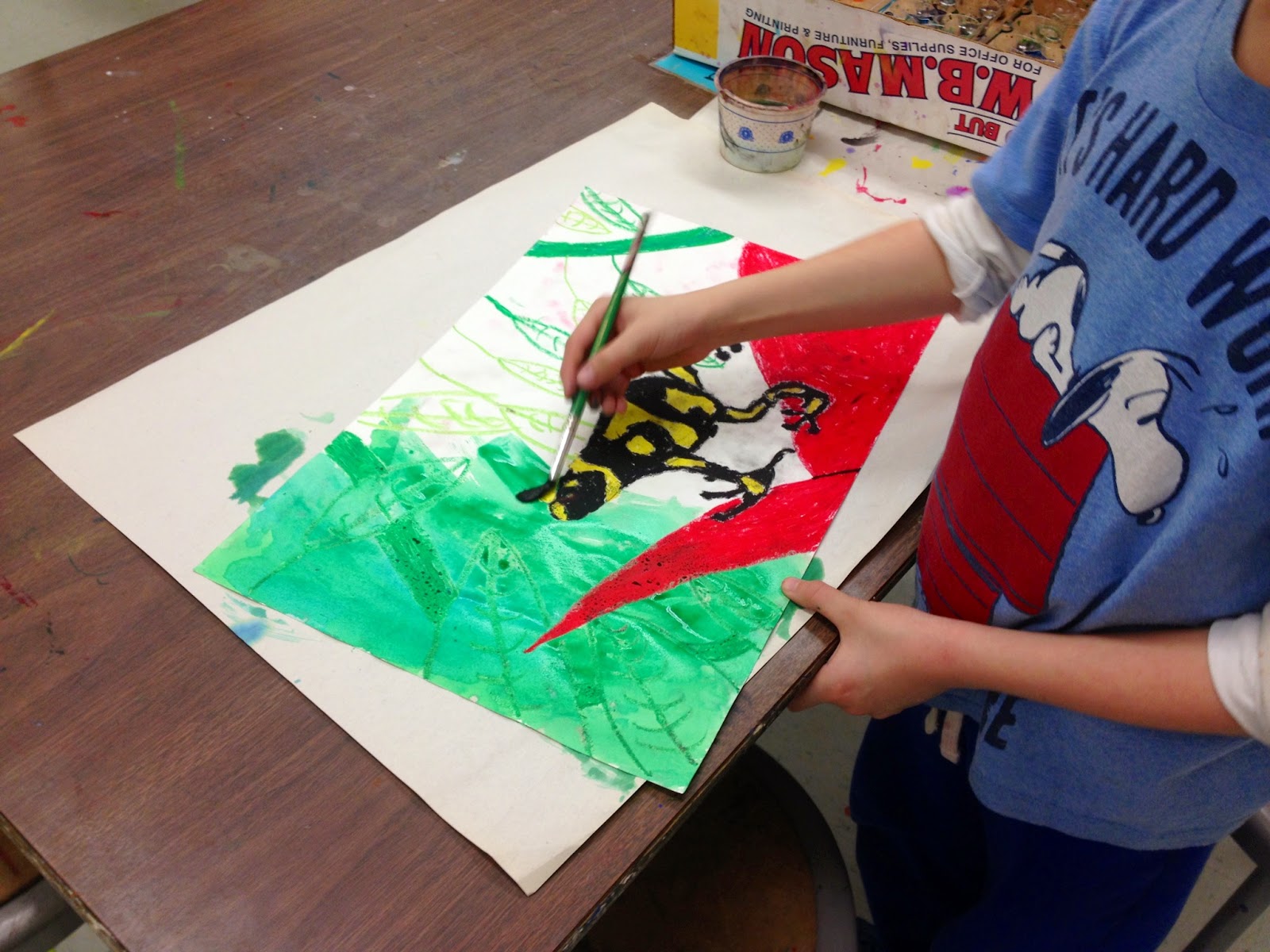
Students selected one animal to sketch, using reference images, and drew the animal it its rainforest habitat. Using oil pastels, students added color and thought about the texture of their chosen animal. 
During the following class, students added select details to the background to suggest the Amazon rainforest, such as leaves, branches, and vines. Then they painted over their oil pastel drawing with liquid watercolor to create a resist, since the oil pastel and watercolor paint do not mix.
As a conclusion to the project, students participated in a turn and talk, where they discussed their artwork with a partner using special fortune tellers to help start the conversation. 
We also came up with titles for our work and had a gallery walk to see everyone's finished artwork. Students shared their observations afterwards, noticing that everyone included the rainforest environment in their backgrounds and focused on the texture and pattern on their animal's body. Here are some finished examples:
Zach, 2nd Grade
Emma, 2nd Grade
Jaylyn, 2nd Grade
Jefferson, 2nd Grade
Kate, 2nd Grade

Tuesday, March 31, 2015

Wayne Thiebaud Inspired Dessert Paintings

After exploring color mixing recently, 3rd grade artists looked at and discussed the work of American painter Wayne Thiebaud. Thiebaud (pronounced "tee-bow") is known for his paintings of everyday objects, like food.
Wayne Thiebaud, Cakes (1963)
Wayne Thiebaud, Four Cupcakes (1971)

We looked at his paintings of different kinds of desserts and noticed his use of bright colors -- even in some of the shadows. They are often painted on a white or plain background without a lot of detail, so the focus is really on the dessert. Looking at several examples made us hungry!
Wayne Thiebaud, Four Ice Cream Cones (1964)
To begin our own paintings of desserts, we looked at the geometric shapes and forms that make up a lot of our favorite desserts. They can be broken down into basic shapes to start, and then decorative elements and color can be added.
We brainstormed and drew a few sketches of our favorite desserts before selecting one to sketch out on larger paper. The following class, we used our recent experience with mixing colors to paint our favorite desserts!

We thought about how we could mix a variety of colors, thinking about the bright colors that Thiebaud uses in his painting, as well as use white to create tints of color. Students painted their desserts, incorporating tints, and also painted the background, considering the use of a complementary color.
The following week, students added additional details using oil pastels. Students thought about how they could make their cakes, ice cream cones, sundaes and doughnuts really stand out by adding creative details like frosting, sprinkles and hot fudge. 
Since Wayne Thiebaud's paintings are also characterized by their strong shadows, we looked at cast shadows and how the shape of the object changes the shape of the shadow. Using a flashlight and a marshmallow, we also noticed that the placement of the shadow depends on the direction of the light source. Students added a colorful shadow to their dessert using oil pastels.
On the last class, students added finishing touches and came up with a title for their artwork, which they wrote on index cards. Then we had a gallery walk to look at everyone's work and shared observations afterwards. 
Students noticed that their classmates had added a variety of different details, such as making a birthday cake or adding colorful details to an ice cream sundae. We also appreciated the titles that everyone came up with, as some were quite creative! Here are some mouthwatering examples of our Wayne Thiebaud inspired desserts:
Rosemary, 3rd Grade
Annie, 3rd Grade
Alec, 3rd Grade
Mason, 3rd Grade