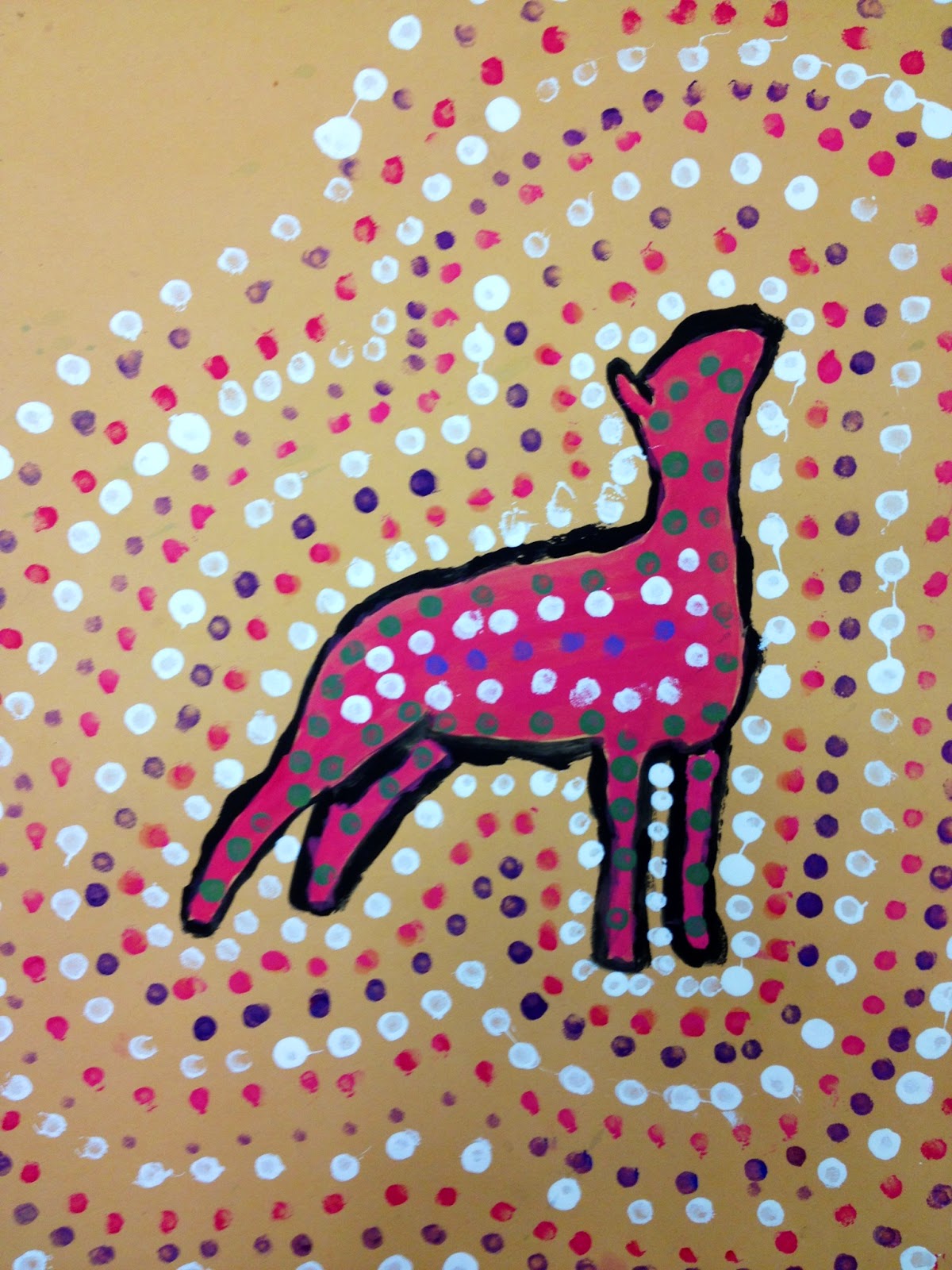
Artists in 4th and 5th grades finished their Aboriginal Animal Dot Paintings before winter break, adding dots to the background around the body of their chosen animal (and listening to more didgeridoo!). We then spent a class discussing, looking at and reflecting on our artwork.
.JPG) |
| Sadie, 5th Grade |
We did this in 3 different ways: a turn and talk, gallery walk, and written self assessment. For the turn and talk we partnered up with classmates and used fortune tellers that were made especially for talking about artwork. They work similarly to regular fortune tellers, except instead of fortunes, they ask questions about your artwork. They acted as a tool to help jump start our conversations so we could reflect on our work and tell each other about our artistic choices.
Next was the gallery walk. We walked around the room quietly, going from table to table to see each other's artwork. We shared observations that we noticed from each other's artworks and it was interesting to see that they all came out very differently!
Among many other things, we noticed that some students used bright colors and some used colors that were more natural for the animal, the space between the dots varied, and some students added patterns to the animal's body.
The last part was a written self-assessment to reflect on our artwork. We had to consider whether it met the criteria we had been working on, including featuring an Australian animal, using at least 5 mixed colors, and creating a pattern with the dots. Students were able to think back to the responses they had during the turn and talk to answer some of the questions, such as "What are you most proud of in your artwork and why?"
.JPG) |
| Saleena, 4th Grade |
Students took their time to think through the questions and reflect on their work, which was evident in their completed self-assessments. It was interesting to read that several students had a personal connection to the animal that they chose, whether it was as a pet or having seen the animal on a trip.
.JPG) |
| Eleni, 5th Grade |
Students were most proud of the range of colors that they mixed and how carefully they painted their animal. The most challenging part of this project was definitely the dots! As one student wrote, "sometimes the q-tips just did not cooperate with you." It was also challenging to mix the same color for the dots in order to repeat the pattern.
.JPG) |
| Ashley, 4th Grade |
Some of the paintings will be up in the glass case downstairs on the first floor soon, so look out for those. In the mean time, here are some examples:
.JPG) |
| Anas, 5th Grade |
.JPG) |
| Kelsey, 4th Grade |
.JPG) |
| Catherine, 5th Grade |
.JPG) |
| Esmeralda, 4th Grade |
Artists in 4th and 5th grades have been learning about the dot paintings of the Aboriginal people of Australia. We looked at some examples of their paintings, which help tell the story of their lives and history. Aboriginal artists used different symbols to help tell their story in pictures, and also used colors that had cultural meaning.
We began our own dot paintings by selecting animals native to Australia and drawing and painting them as simple outlines on brown paper. We noticed that the Aboriginal artists flattened out their animals, often showing them from a bird's eye view, so we did the same. We also used different shades of brown paper to resemble the tree bark and rocks that the Aboriginal people painted on.
We spent a day exploring color mixing, so we could create a variety of different colors using just our primary colors as well as white, and refresh our color mixing minds.
We then painted our animals, using at least 5 colors that we mixed. We added dots by using a very special tool -- a q-tip! We thought about how we could use color to create a pattern with the dots.
Painting took a few classes, so during one of them we learned about an Aboriginal instrument called the didgeridoo, which is a wind instrument developed by the Aboriginal people around 1,500 years ago and is still used today. Traditionally it was made out of wood
that was hollowed out by termites and beeswax was used to form a
mouthpiece.
We looked at one owned by Ms. Patashnick, the music teacher, that was made from a PVC pipe and we noticed it also had a pattern of dots painted on the outside. We watched a video of someone playing didgeridoo and noticed that different sounds are produced by different ways of breathing into the instrument, since there are no holes or keys. We have been listening to didgeridoo music as we paint.
 |
| Lena, 5th Grade |
Check back soon to see updates on our finished Aboriginal animal dot paintings!

.JPG)

.JPG)


